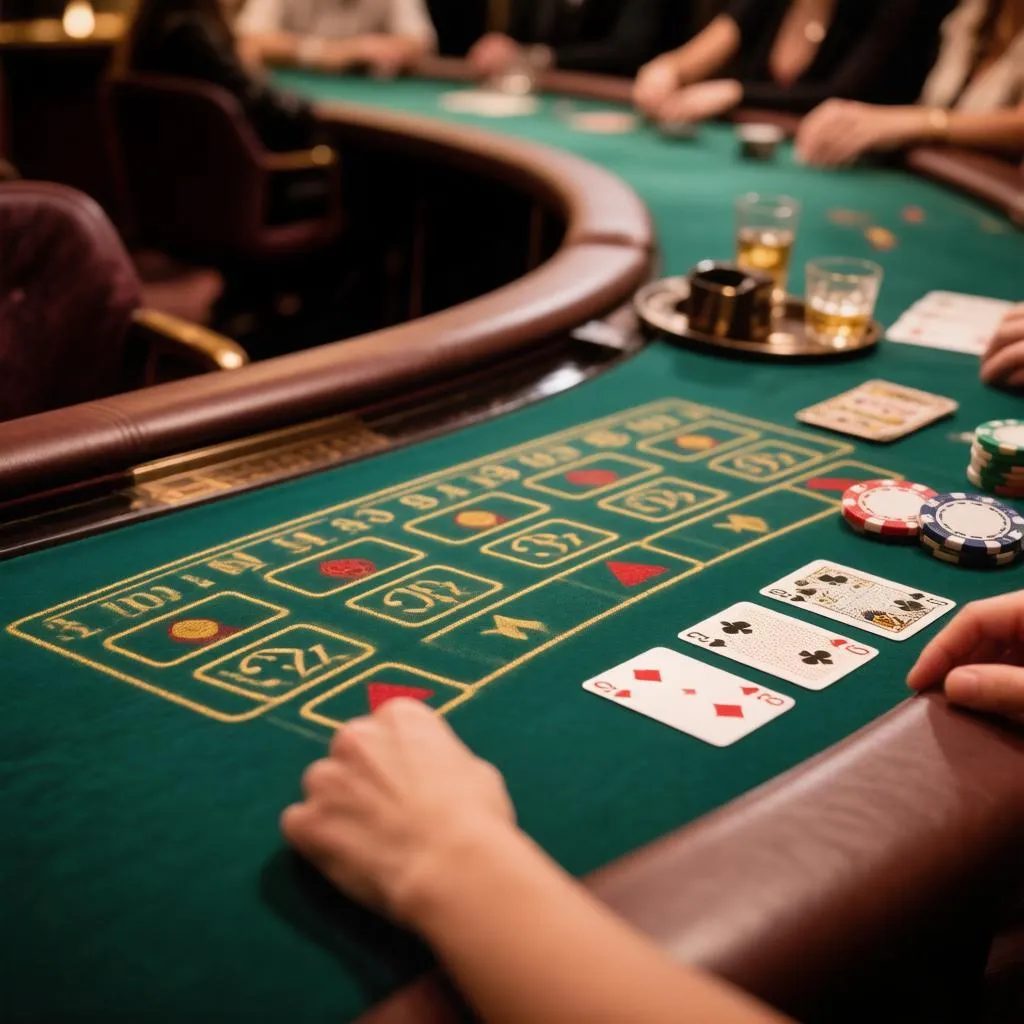
Watch a live blackjack table for twenty minutes and you will see the same scene repeat: a player draws to a hard 16 against a dealer’s 10, wins the hand, and walks away convinced that basic strategy “doesn’t work.” The next hour, another player stands on the same 16 against the same 10, busts the dealer’s two-card 20 instead, and concludes the opposite. Both are fooled by the same illusion — that a single hand’s outcome can validate or invalidate a decision made thousands of times. Basic strategy is not a prediction of the next card; it is the mathematically optimal play for every combination of your hand and the dealer’s upcard, calculated over millions of simulated hands, and its value emerges only across volume. Played perfectly, it reduces the house edge to roughly half a percent — the lowest edge in the casino, and the entire reason blackjack survives as a serious player’s game. Played with “instinct,” the edge triples or worse. This guide provides the complete chart, explains the logic behind the moves that feel wrong, covers the handful of deviations that are actually justified, and addresses what changes — and what does not — when the dealer is a human being on a video feed rather than a random number generator.
What basic strategy is and why it works
Basic strategy is the set of decisions that maximizes expected value for every possible starting hand against every possible dealer upcard, assuming the only information available is your two cards and the dealer’s one. It was computed originally in the 1950s by probability pioneers using desktop calculators and has been refined since into the universally consistent chart that exists today. The chart’s authority comes from exhaustiveness: for every combination — 16 against 7, soft 18 against 9, pair of 8s against 10 — the strategy states the single play with the highest expected return, and the margins between the correct play and the alternatives are often fractions of a percent that only appear across thousands of hands.
Two principles generate almost every line of the chart, and understanding them makes the chart learnable rather than memorizable:
- The dealer is forced to play by fixed rules. The dealer must hit to 16 and stand on 17 — no judgment, no choice. This rigidity means the dealer’s upcard reveals a probability distribution of final hands: a 6 upcard busts more than 40% of the time, while a 10 upcard busts less than a quarter of the time. Every basic strategy decision is ultimately a bet on that distribution.
- Your decisions change your expected value but not the deck. Unlike the movies, no playing style affects which cards arrive; the only variable under your control is what you do with the cards you get. This is why the strategy can be total: every situation has one best answer, and the chart is that answer written down.
The consequence of these two principles is the chart’s most counterintuitive property: it sometimes instructs plays that lose far more often than they win. Hitting a hard 12 against a dealer’s 2 or 3 loses more than half the time — and is still correct, because standing loses even more across the long run. The player who judges each hand by its outcome is measuring noise; the chart measures expectation.
The complete basic strategy chart
The chart below covers the standard game most live tables offer: dealer stands on soft 17 (S17), doubling after split allowed, late surrender available, eight decks. Hard hands come first, then soft hands, then pairs — and reading the columns by dealer upcard from 2 through ace is the skill that turns the table into instinct.
Hard totals (no ace counted as 11):
| Your hand | 2–6 (dealer) | 7–9 | 10 | A |
|---|---|---|---|---|
| 8 or less | Hit | Hit | Hit | Hit |
| 9 | Hit | Hit | Hit | Hit |
| 10 | Double | Double | Hit | Hit |
| 11 | Double | Double | Double | Double |
| 12 | Stand | Hit | Hit | Hit |
| 13–14 | Stand | Hit | Hit | Hit |
| 15 | Stand | Hit | Hit | Hit (surrender*) |
| 16 | Stand | Hit | Hit (surrender*) | Hit (surrender*) |
| 17+ | Stand | Stand | Stand | Stand |
*With late surrender available: 15 surrenders against a 10, and 16 surrenders against 9, 10 or ace.
Soft totals (ace counted as 11):
| Your hand | 2–6 (dealer) | 7–9 | 10 | A |
|---|---|---|---|---|
| Soft 13–15 | Hit | Hit | Hit | Hit |
| Soft 16–17 | Double (else hit) | Hit | Hit | Hit |
| Soft 18 | Double (else stand) | Stand (hit vs 9) | Hit | Stand |
| Soft 19+ | Stand | Stand | Stand | Stand |
Pairs:
| Your pair | 2–6 (dealer) | 7–9 | 10 | A |
|---|---|---|---|---|
| A, A / 8, 8 | Split | Split | Split | Split |
| 2, 2 / 3, 3 | Split | Hit | Hit | Hit |
| 4, 4 | Hit | Hit | Hit | Hit |
| 5, 5 | Double (as a 10) | Double | Hit | Double |
| 6, 6 | Split | Hit | Hit | Hit |
| 7, 7 | Split | Split | Hit | Hit |
| 9, 9 | Split | Split | Stand | Split |
The chart’s famous and most misunderstood entries are the pair of 8s against a 10 and the pair of aces everywhere. Splitting 8s against a 10 feels like doubling a loss — but sixteen is the worst total in the game, and two separate hands starting from 8 lose less in total than one hand starting from 16. The pair of aces splits always because each ace-armed hand has a chance to reach 21 or a high total, while an ace-counted-as-11 hand that cannot be improved beyond soft 18 wastes the best starting card in the deck.
Rule variations that shift the chart
Live tables differ in rule sets, and the chart above assumes the common baseline. The rules that matter most, in descending order of impact on your expected value:
- Dealer hits soft 17 (H17) instead of standing (S17). This single rule worsens the edge by roughly 0.2%, and it changes three chart cells: soft 18 becomes a hit against a dealer 2 and ace in addition to the 9, and hard 15/16 surrender points expand slightly. Most live studios run both versions on different tables, so the table selection itself is a strategy decision.
- Doubling after split (DAS) allowed or not. With DAS allowed — the majority of live tables — pairs of 2s, 3s and 7s become split plays against broader dealer ranges, including the 2 and 3. Without it, those pairs revert mostly to hit plays.
- Surrender availability. Late surrender adds back roughly 0.08% and creates the surrender cells marked in the hard-hand chart. On tables without surrender, the same hands revert to the hit instruction.
- Blackjack payout. The classic 3:2 is the standard, but a growing share of live tables pay 6:5, which alone adds nearly 1.4% to the house edge — the largest single penalty in the game. No basic strategy chart compensates for a 6:5 table; the correct play is to walk to a different table.
- Number of decks and resplit rules carry smaller effects, but the trend is constant: fewer player options and more decks always favor the house.
The practical conclusion from this list is that rule awareness outranks memorization precision. A player with a perfect chart on a 6:5 table loses more per hour than a player with a slightly imperfect memory on a 3:2 S17 table with surrender. Check the rules printed on the table’s digital banner before the first hand — the information is always displayed.
When to deviate: the honest exceptions
Basic strategy’s authority holds until composition-dependent counting enters the picture, and the honest answer to “when should I deviate” divides into three tiers: deviations justified by card counting, deviations justified by specific live-table conditions, and deviations that are always wrong despite feeling right.
The deviations with actual mathematical support:
- Count-based deviations (for counters only). A high count makes standing on hard 16 against 10 correct; a low count makes hitting 12 against 3 correct. These plays are the “Illustrious 18” of professional play, and they are worth roughly 0.1–0.3% to a competent counter. For a non-counter, they are noise — the count must actually be known, and a true count requires tracking every card at a live table where dozens of players receive cards between shuffles.
- The 6:5 reality check. Not a deviation from the chart but from the table: the optimal response to a 6:5 payout is reduced stakes or a different table, and no in-hand adjustment repairs the damage.
- Multiplayer pace considerations. Live tables with seven seats change nothing about the strategy — the chart applies identically — but they change its cost of execution: the strategic player loses nothing by pausing a second before acting, and that pause is where imperfect memory gets corrected. Use the shared table’s natural pace to verify rather than react.
The deviations that feel justified and never are: standing on 16 against 10 “because the dealer looks due,” taking insurance without a count (insurance is a losing bet except when the remaining deck is ten-rich — precisely what a counter knows and a casual player does not), hitting soft 18 against 2 through 6 “because 18 feels weak,” and splitting 10s under any circumstances. Each of these costs measurable expected value, and the losses compound: a player making three of these “intuitive” adjustments per session has surrendered most of basic strategy’s edge.
Live-specific considerations: what changes at the video table
The live dealer format changes the environment of play more than the mathematics of it, and a strategy-aware player adapts the former while keeping the latter untouched. The differences that matter:
- Continuous shuffle machines and shallow penetration. Many live tables cut the shoe early or use continuous shufflers, which reduces the value of card counting to near zero — the information from seen cards washes out too quickly. This is not a disadvantage for basic strategy players, whose approach requires no information about the deck’s composition; it is, however, the end of most live-counting ambitions.
- Multiplayer shared hands and timed decisions. The decision timer — typically 10 to 15 seconds — punishes hesitation but rewards preparation: a player who has internalized the chart plays instantly, and a player who must look up the chart every hand degrades the experience for the table. This is the practical argument for memorization beyond the mathematical one.
- Side bets are traps in every format. Perfect pairs, 21+3, insurance and the rest carry house edges from 3% to well over 10% — multiples of the main game’s edge. No basic strategy extends to them because none exists that makes them correct; the main hand’s half-percent edge is the only economy worth funding.
- Minimum bet selection as strategy. The bankroll discipline of live blackjack is straightforward: a session bankroll of at least 25–40 times the table minimum survives normal variance long enough for the half-percent edge to be the story, rather than a short-run swing.
None of these live conditions alter a single chart cell — the chart is universal across live and RNG blackjack with identical rules — and that invariance is itself the reassurance: learn one strategy, apply it anywhere, and the human dealer on the screen is playing the same forced rule set the mathematicians modeled in the 1950s.
How to learn the chart without hating the process
Memorizing 180-odd cells sounds intimidating and is not, because the chart clusters into a handful of principles covering most hands. The efficient learning sequence:
- Learn the stands first. All totals of 17 and above stand; all hard 13 through 16 stand against dealer 2–6. This one rule covers roughly a third of all decisions.
- Learn the soft-hand rule. Soft 18 stands against 2, 7 and 8, hits against 9, 10 and ace, doubles against 3–6. Soft hands are where doubling pays most, since an ace can be recycled as a 1 if the draw would bust.
- Learn the pairs. Aces and 8s always split; 5s and 10s never split; everything else follows the “split against weak upcards, hit against strong” pattern from the chart.
- Drill with a trainer before a real table. Free basic strategy trainers online correct each wrong answer instantly, and twenty minutes daily for a week produces near-perfect recall — a trivial investment against a skill worth half a percent of every blackjack bet for life.
- Accept the chart’s verdicts emotionally. The final skill is not memory but obedience: the losing plays that are still correct (16 against 10) are where untrained instinct does its damage, and the trained player trusts expectation over outcome every single hand.
Conclusion
Basic strategy is the rare casino system that is not a myth: computed, verified and stable for seventy years, it converts blackjack from a high-edge game of guesses into a low-edge game of execution, and the half-percent edge it leaves standing is the price of admission for a game that is otherwise beatable in structure. The chart in this guide covers the standard live format; the rule variations section tells you where the cells shift; and the deviations section delivers the honest summary that only counters deviate profitably, while everyone else’s instincts subtract value.
The execution plan is unglamorous: learn the chart in the five-step sequence above, verify the table’s rules before sitting down, decline every side bet, size your bets so variance cannot end the session early, and measure your results in hundreds of hands rather than dozens. Live blackjack rewards exactly this kind of patience — the dealer’s rules are fixed, your decisions are the only variable, and the player who plays every hand by the chart loses slowly, learns accurately and, on the sessions where variance cooperates, wins the way the mathematics says a half-percent-edge game occasionally should. That is not excitement by instinct — it is excitement by design, and it is available at every live table that pays 3:2 to anyone who takes the chart seriously.